

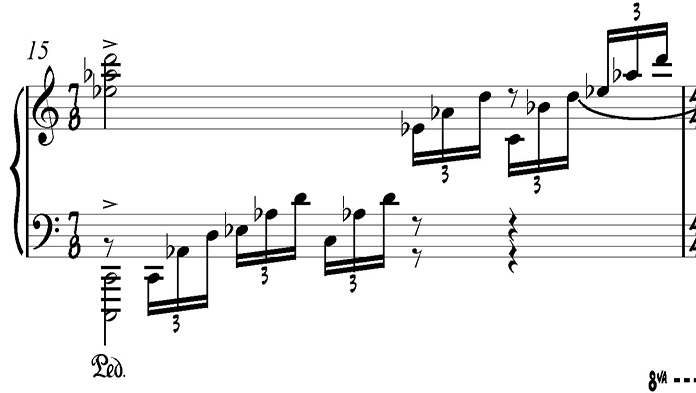
The process of notating music used to be called 'engraving', which involved etching into metal for mass reproduction of professional-looking sheet music.
These days computers do the job, but the computer operator still has to know about the conventional writing process in order to avoid errors, and to optimize the sheet music in terms of comprehension by the musician. Thus, music copying tends to involve a fair amount of inner hearing and relies on one's musical experience. The best music copyists are artists, because music copying is an art!
When I was taught to compose, the way you wrote down ideas was considered part of the skill of composing. I remember using a fountain pen, making my own manuscript paper, and sticking "Notaset" letraset dry transfer symbols on my staves! I still draw from this experience when preparing sheet music on the computer.
TYPES OF MUSIC COPYING JOBS
There are different reasons people hire a music copyist.
One reason is simply for the "engraving" service, i.e. to turn someone's illegible manuscript like this:
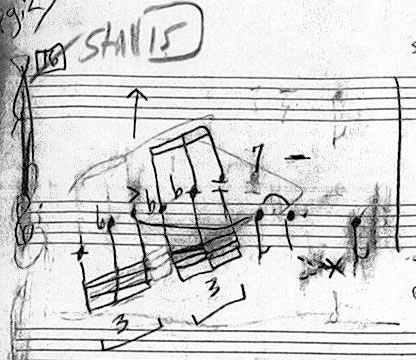
Into something that the composer (and others) can read, like is shown at the top of this page. (Yes, it is the same excerpt for piano!)
Once professional-looking sheet music like this is prepared, the composer or producer can hire musicians to perform and record the music in the studio, safe in the knowledge that the composer's original intentions are going to be communicated as clearly as possible. Poorly prepared sheet music seems to have a negative effect on professional musicians. Even if they can read and interpret it, it reflects poorly on the composer, and musicians tend to take the project less seriously and put less energy into the project, be it a recording or performance.
Another reason to have your composition/tune/song "engraved" is to enhance and support it's origin as your original creative work. That is, having your music professionally presented can be a positive step towards establishing the connection between the work and the composer.
ARRANGING
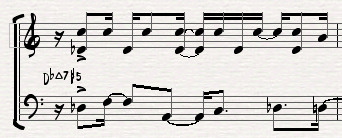
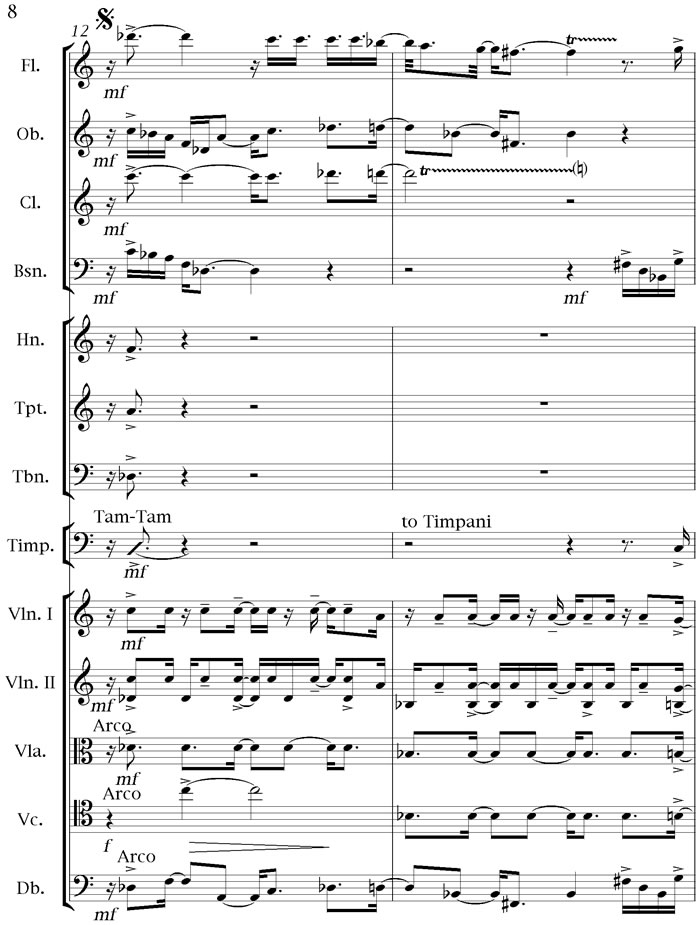
A music copyist may also act as an arranger, taking a composition on one instrument or set of instruments and translating it into a wholly different ensemble. Take for instance, this fragment for bass and guitar, on the left below, which has been "exploded" out to a chamber orchestral arrangement of mine, on the right:
TRANSCRIBING
Musicians also hire music copyists to help them create sheet music from recordings. The act of transcription relies on a very well-developed ear, as well as a broad range of experience as a reader and performer, so that an appropriate representation of the music is made into notated form. I possess such a skill-set, developed over more than 35 years. A professional transcriber can therefore achieve something that no computer can. I assist musicians lacking literacy and aural skills to create written compositions from their own performances. Singer/songwriters and self-taught musicians lacking knowledge of music theory can benefit greatly from having their music committed to notation. It not only aids its dissemination into the greater music scene but also helps with maintaining concrete records for copyright and authorship purposes.
Furthermore, musicians often find great advantage from working on other people's music. Often this is not available in written form, so a transcription of, say, Charles Mingus bass lines helps the bassist to enter into the creative world of Mingus' music. Again, it gives the musician something concrete to focus on in their practice.
There are a few examples of my transcriptions on the right section of this page under sample transcriptions. These are excerpts from examples of actual work for clients.
EDITING
Very often two pairs of eyes are better than one. Given the complexity of music, and the sometimes severe time restrictions a composer/arranger has in creating music, a music editor can be very handy when it comes to checking scores and parts. A good music editor makes a composer much more respected by his or her musicians and employers, because of the elimination of errors. Recording sessions go more smoothly, saving time and money.
REFERENCES"To all you singer/songwriters out there: If you are looking for a top-notch service to transcribe/transpose your songs, look no further. Jonathan Dimond does excellent work at affordable prices. He is very efficient and can usually have your fully notated song back to you within a week's time. This guy is a winner!"
Michael (Boston, MA., USA. October 2005)"You're so fast and so gracious; I really value our working relationship."
Dave Stern, pianist/composer (Cambridge, MA., USA. November 2005)"Jonathan did a great job transcribing some Paul Chambers solos for me. I recommend his work to anyone interested in exploring the jazz language. His transcriptions are clear, precise, and educational. I look forward to having more transcriptions by him in my music collection."
Paige Smith, bassist (Melbourne, Australia. September 2014)"I am delighted with the sheet music. I look forward to working with you on another project."
Beecher Wood, cellist (Louisiana, USA. June 2015)"I have been working with Jonathan as score editor on a composition project. His editing is always first rate, prompt, musically valuable, and he is always very easy to deal with. The quality of his work is uniformly high, while the costs of his work are uniformly reasonable. If a similar project arises I will look to him first for any needed collaboration!”
Michael Wm. Gilbert, composer (Amherst, MA., USA. May 2017)"Jonathan was always very professional, personable, and prompt in his transcription and arrangement of my songs. His expertise in not only transcribing/arranging my songs but in filling in the blanks (so to speak) helped me to be able to realize my dream. He helped to transcribe/arrange my songs from MP3s of myself singing the songs and emulating the sound of the guitar melody into full band compositions and MIDI tracks. I was utterly amazed at how the sheet music when played and MIDI tracks sounded precisely how I imagined. Previously these songs have only been in my head. With his brilliant, musical mind, this dream of sharing my music with the world can now be achieved."
Keith Morgan Schifano, singer/songwriter (Bethlehem, PA.,USA. November 2018)"You are amazing! I can't believe how fast you were able to transcribe such an intricate and technically challenging piece! And it's all spot on too! You have an amazing ear for music! I've been working on the introduction you sent me all evening. Thank you so much! I love it!"
Hugh Howard, pianist (LaVerkin, UT, USA. January 2019)"Jonathan has just completed transcribing one of my classical piano compositions. I can only say that his work is impeccable and his help and support was impressive. I would highly recommend his services to any musician seeking a professional transcription of their work!!!"
Robert Stevenson, composer (London, U.K. August 2020)"I needed help with charts for a project and Jonathan was fast, accurate and accommodating and turned everything around very quickly. Thank you Jonathan!"
Roger Frankham (Sydney, Australia. February 2022)